
The 10 largest cocoa bean buyers paid from US$ 4.50 to US$ 7.17 per kilo in 2026

- Cocoa beans from Ecuador, Peru, Colombia and Mexico sold at an average of US$ 5.33 per kilo in 2026.
- The 10 largest buyers paid from US$ 4.50 to US$ 7.17 per kilo; Atlantic Cocoa paid the most.
- Barry Callebaut, Olam and Cargill declared their own intra-group shipments above the price they paid other Ecuadorian suppliers.
In 2026, cocoa beans exported from Ecuador, Peru, Colombia and Mexico sold at an average of US$ 5.33 per kilo. Behind that average, prices spread widely. The 10 largest buyers paid on average between US$ 4.50 and US$ 7.17 per kilo, so the one at the top paid 59% more per kilo than the one at the bottom.
I went through the customs export records of the four countries, shipment by shipment, to see who paid what. The beans were worth US$ 2.71 billion and weighed about 504,000 tonnes. They went to 387 buyers registered by name in 57 countries. The 10 largest buyers took 43% of the value.
The method is the same for every figure here. Each customs record names the exporter and the buyer, with the net kilos and the declared value. The price per kilo is the value divided by the kilos. I left out shipments with no weight, and shipments where the buyer and the seller are the same company, which I come back to at the end.
After going through the numbers, I think that for a cocoa exporter the price of a kilo depended more on who bought it and in which month than on the country where it was grown.
Origin and month
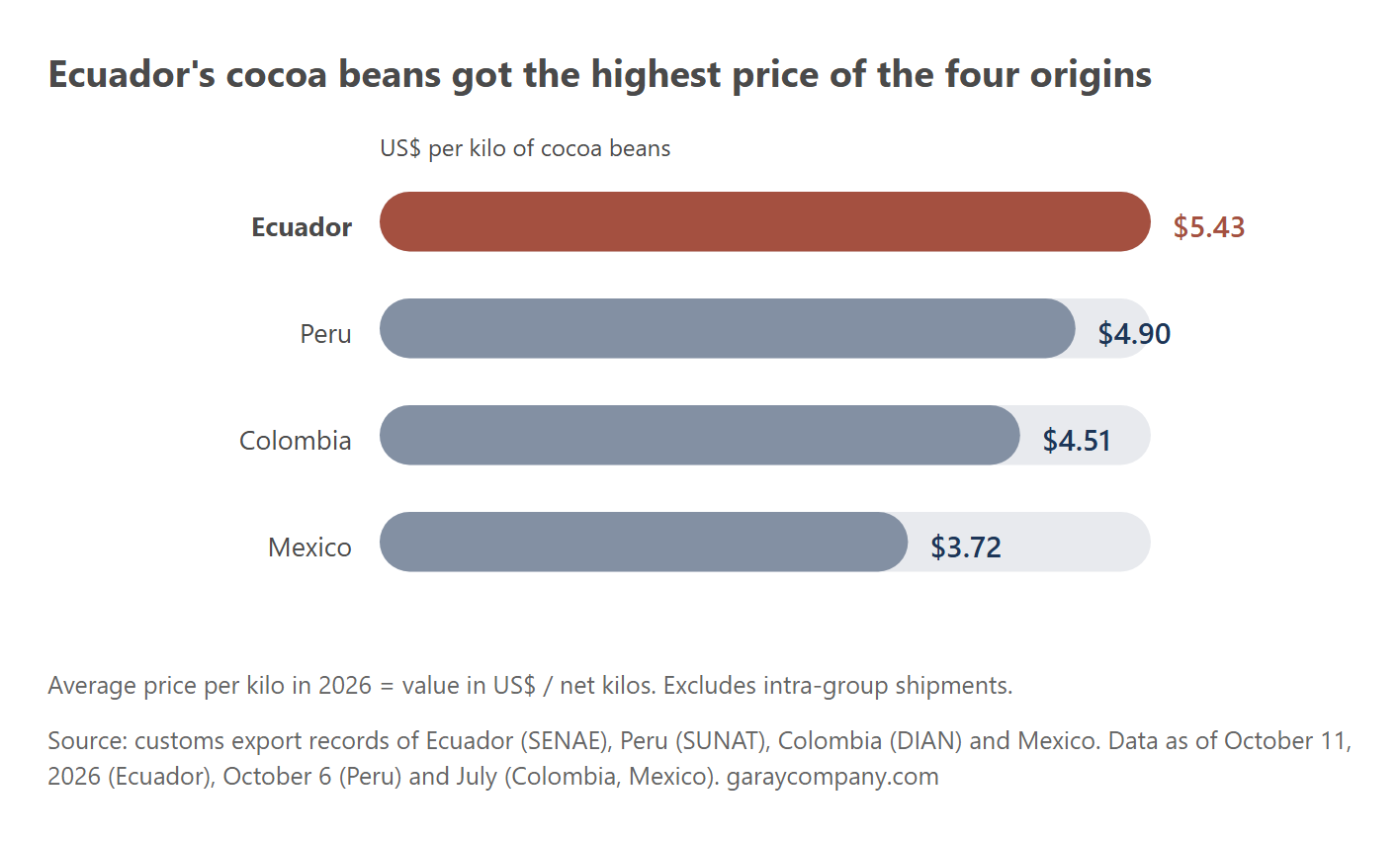
Ecuador shipped 86% of the value of the four countries, and its beans averaged US$ 5.43 per kilo. Peru shipped 12% at US$ 4.90. Colombia, with 1.4% of the value, averaged US$ 4.51, and Mexico, with less than 1%, US$ 3.72.
Between the two large origins, the gap was US$ 0.53 per kilo. Ecuador's beans sold for about 11% more than Peru's.
The beans went mostly to four countries. The United States received US$ 812 million, the Netherlands US$ 457 million, Malaysia US$ 368 million and Indonesia US$ 259 million. Belgium, Canada, Mexico and Germany followed.
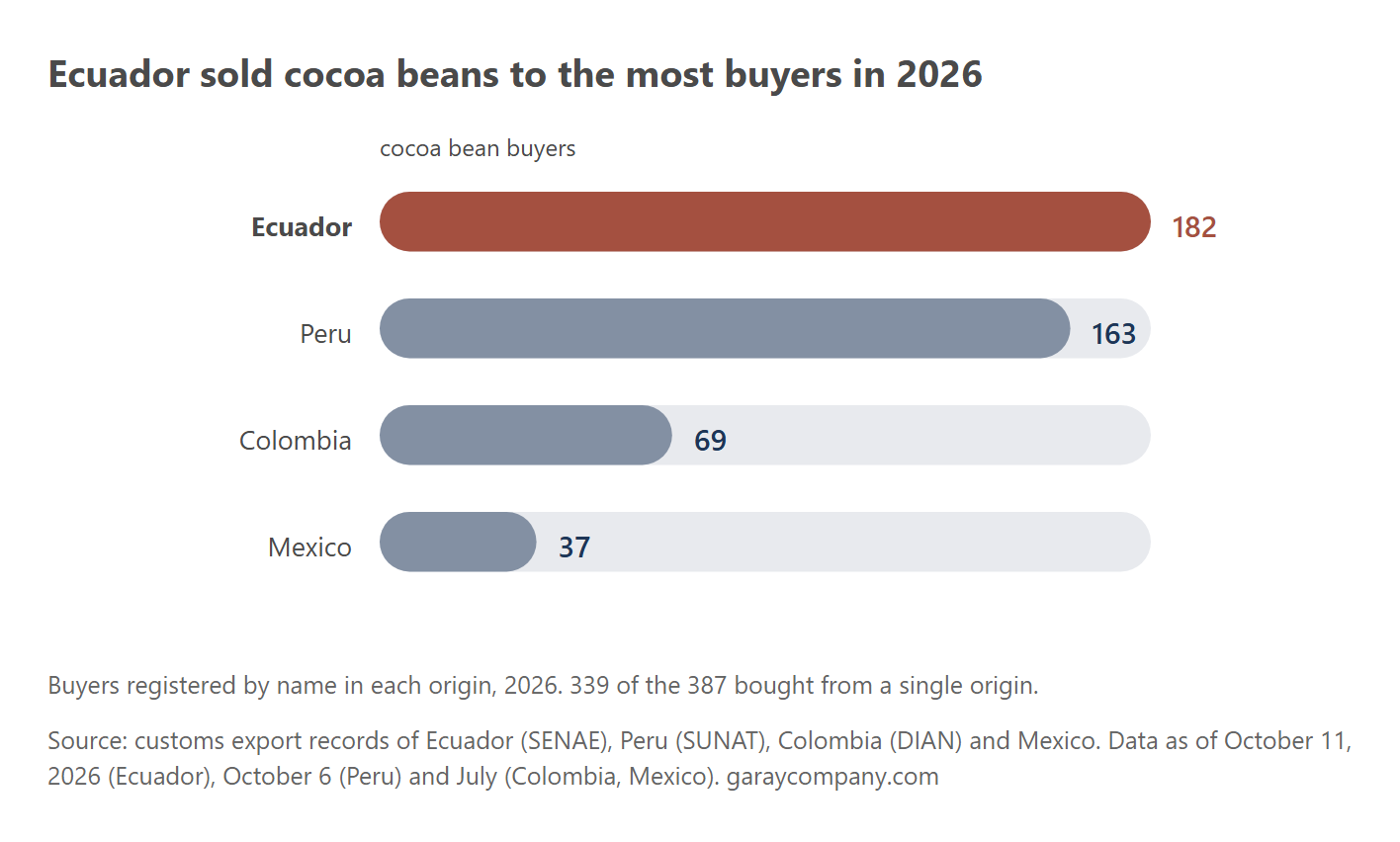
Most buyers stayed with one origin. Ecuador sold to 182 buyers, Peru to 163, Colombia to 69 and Mexico to 37, and 339 of the 387 buyers bought from a single country. Only two bought from all four: Atlantic Cocoa and Original Beans.
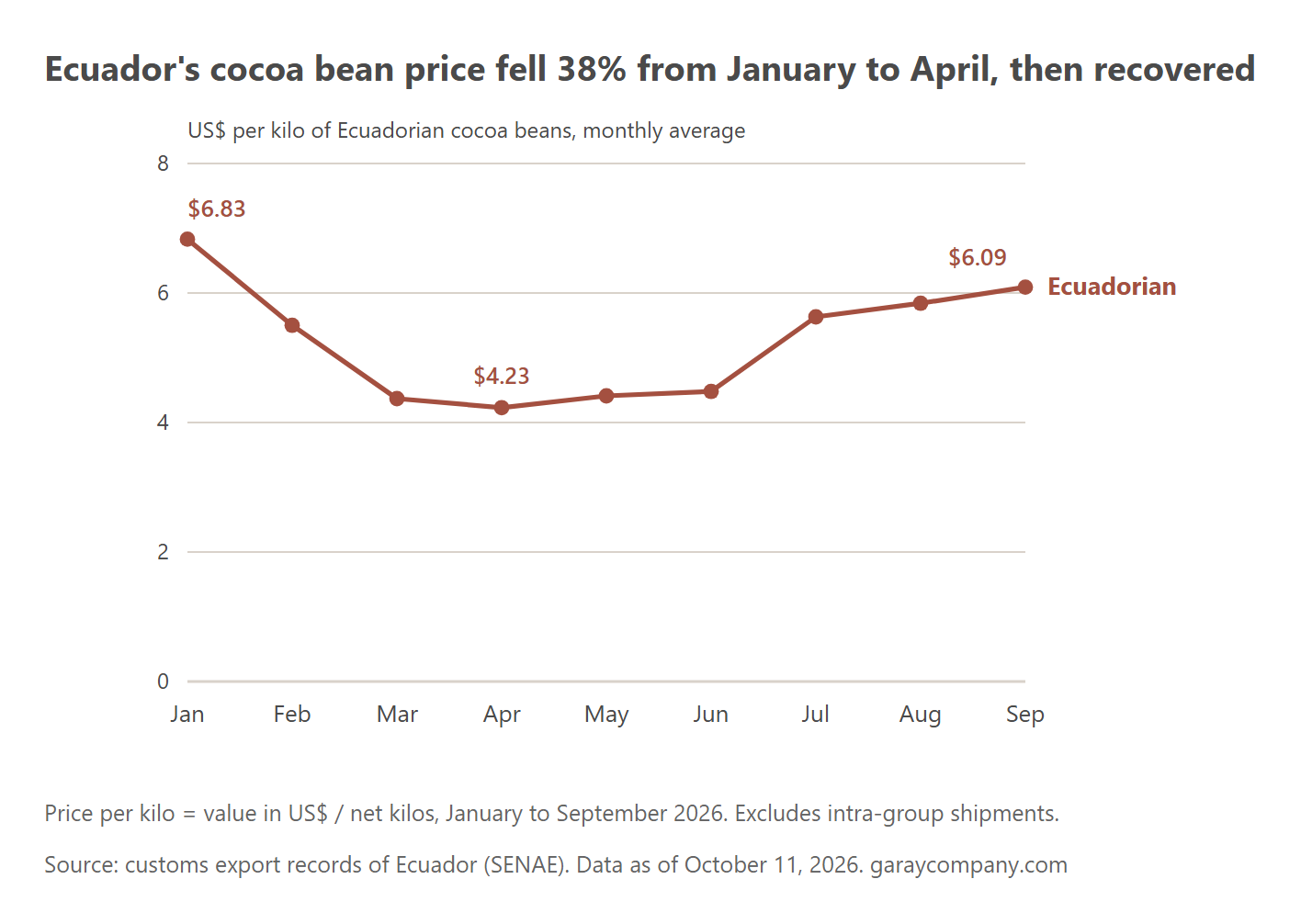
Then comes the calendar, which moved the price more than the origin did. Ecuador's beans averaged US$ 6.83 per kilo in January. By April they were at US$ 4.23, 38% less. In September they were back at US$ 6.09.
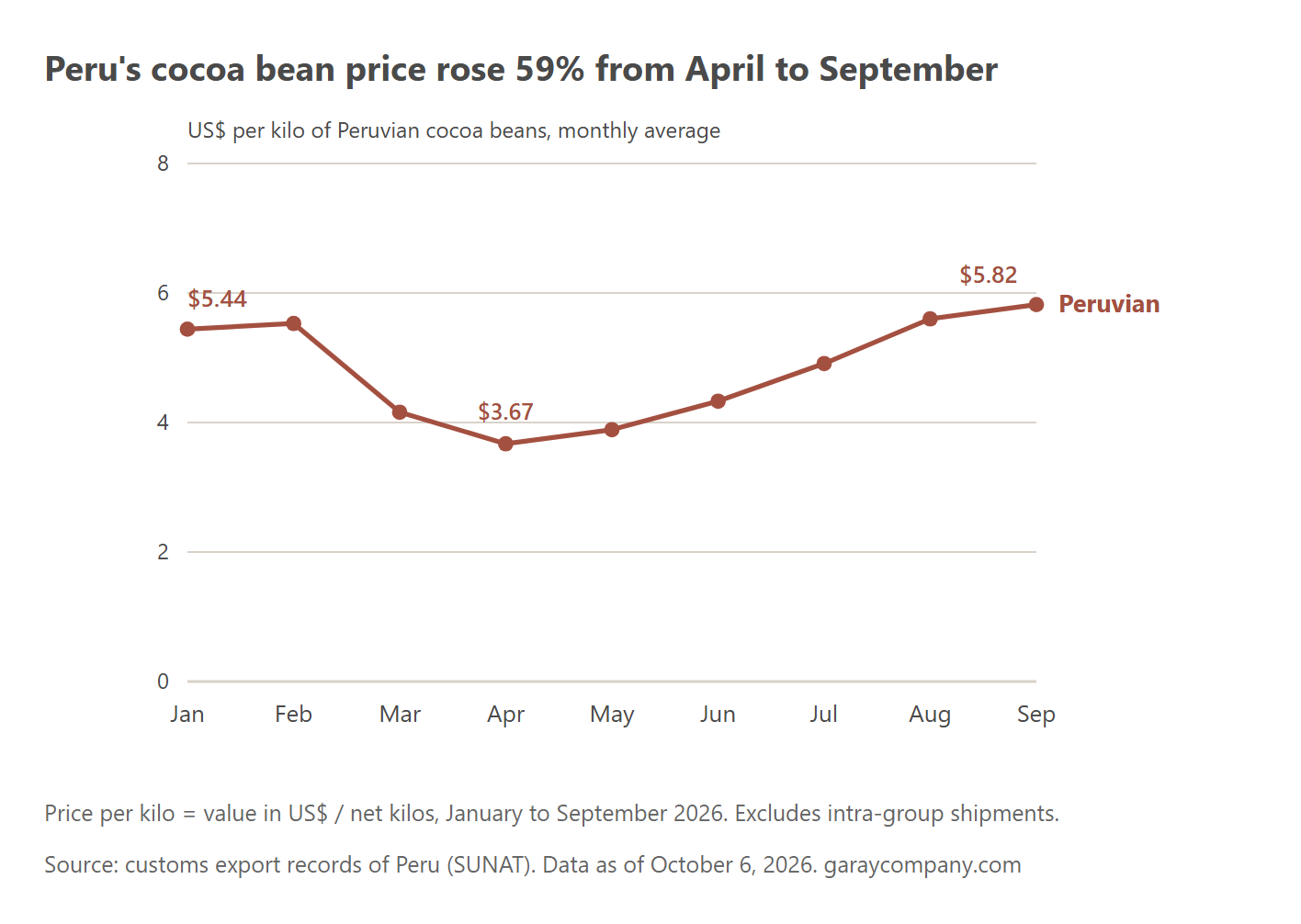
Peru followed the same path. Its beans averaged US$ 5.44 per kilo in January, US$ 3.67 in April and US$ 5.82 in September, 59% above the April price.
In the first six days of October, Peru's beans averaged US$ 6.78 per kilo, the highest monthly figure of the year so far. Colombia's beans moved the same way in the first half, from US$ 5.39 per kilo in January to US$ 3.42 in April and US$ 4.08 in July.
Put the two together and the order between countries flips. A Peruvian exporter who shipped in September got US$ 5.82 per kilo on average, while an Ecuadorian one who shipped in April got US$ 4.23. The yearly average of a buyer, or of a country, depends on which months its shipments left.
Who paid the most
Atlantic Cocoa, from the United States, paid the highest average of the ten, US$ 7.17 per kilo. For Ecuadorian beans it paid US$ 8.21, 51% above the Ecuador average. Agroindustrias Unidas de Cacao, from Mexico, came second at US$ 6.40, with US$ 7.19 for Ecuadorian beans.
The top payer did not pay the top price everywhere. Atlantic Cocoa paid US$ 5.06 per kilo for Colombian beans and US$ 5.13 for Peruvian beans, above the averages of both origins. For Mexican beans it paid US$ 2.79, below Mexico's average of US$ 3.72. Barry Callebaut did the opposite in Mexico, at US$ 5.02 per kilo.
Both bought most of their Ecuadorian beans from the same exporter, Agroindustrias Arriba. Atlantic Cocoa paid it US$ 8.60 per kilo and Agroindustrias Unidas de Cacao US$ 7.47.
The two largest buyers by value paid less than the average of all buyers. Barry Callebaut paid US$ 4.85 per kilo and Cargill US$ 4.87. Olam paid the lowest average of the ten, US$ 4.50.
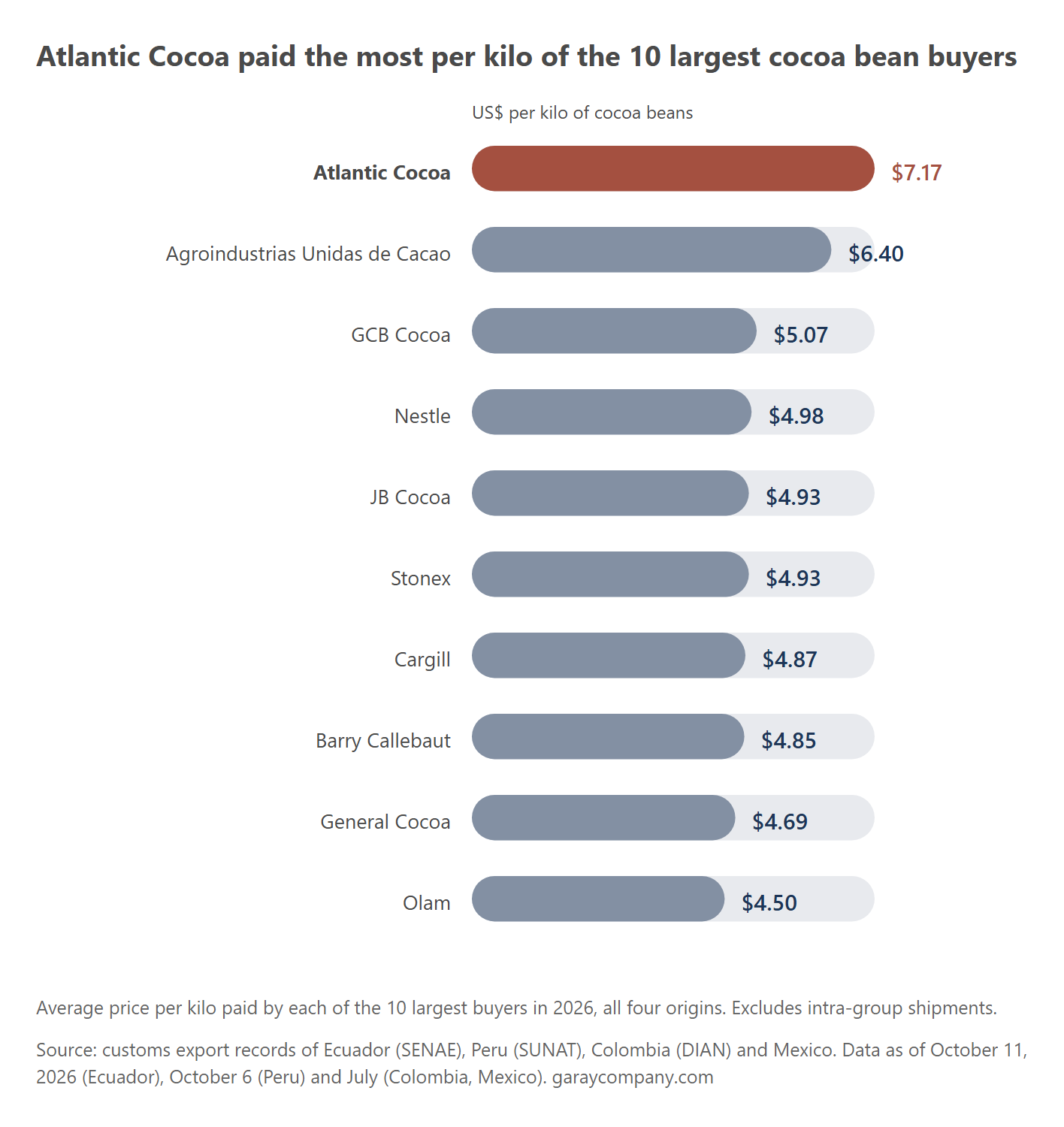
The rest of the ten sat close to each other. GCB Cocoa paid US$ 5.07, Nestle US$ 4.98, JB Cocoa and Stonex US$ 4.93 each, and General Cocoa US$ 4.69.
For Peruvian beans, the ten paid between US$ 3.48 and US$ 5.13 per kilo. General Cocoa paid the lowest and Atlantic Cocoa the highest. GCB Cocoa paid US$ 4.81, Cargill US$ 4.69 and Barry Callebaut US$ 4.37. Agroindustrias Unidas de Cacao paid US$ 4.93, almost exactly the Peru average.
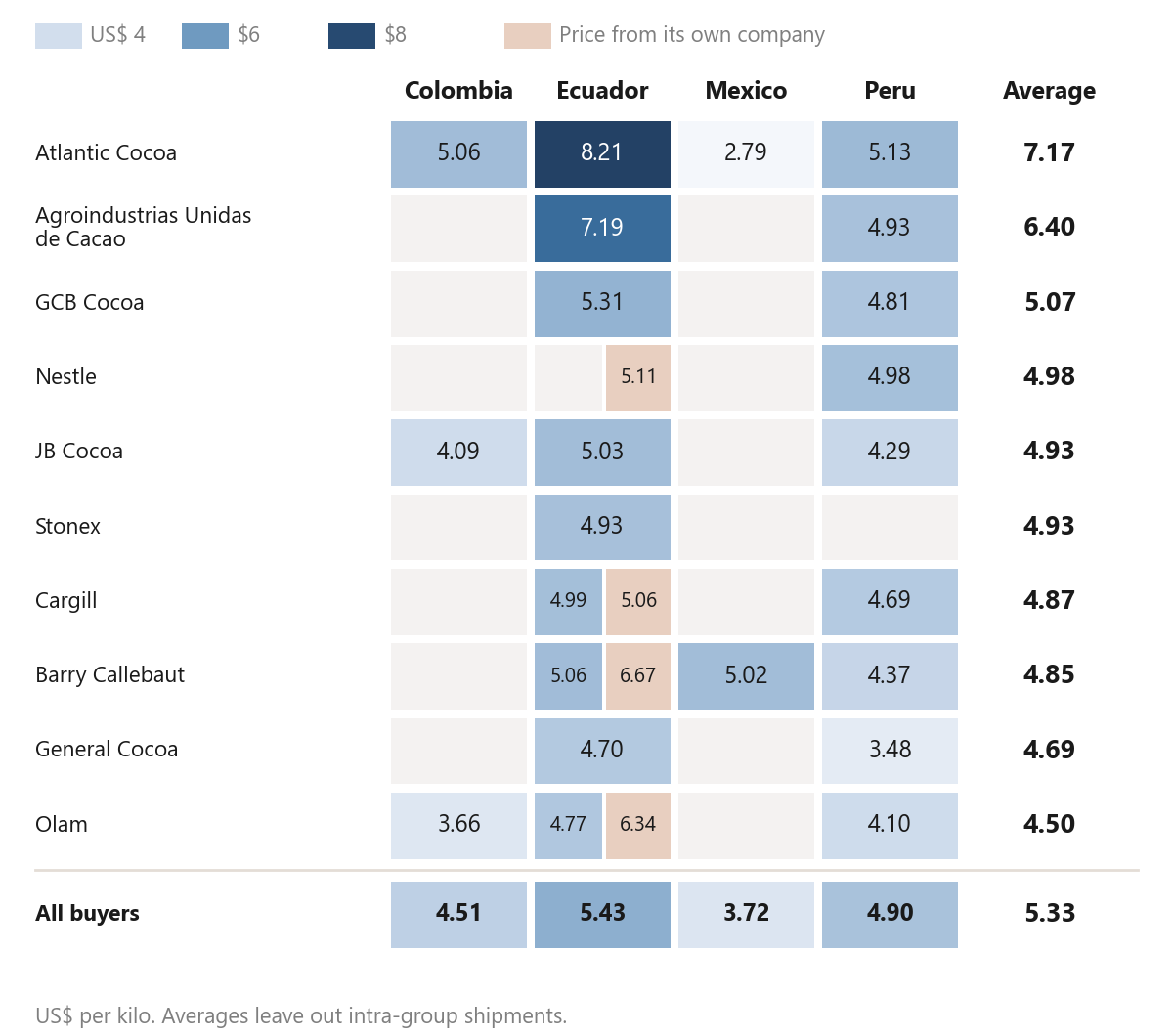
Price per kilo paid by each of the 10 largest buyers, by origin, 2026. Source: customs export records of Ecuador (SENAE), Peru (SUNAT), Colombia (DIAN) and Mexico. Data as of 11 October 2026 (Ecuador), 6 October (Peru) and July (Colombia, Mexico).
The same buyer also paid different prices to different suppliers. Cargill paid Ecuaqao US$ 5.90 per kilo, while its average for Ecuadorian beans was US$ 4.99. JB Cocoa paid its largest supplier US$ 7.43 per kilo, against an average of US$ 4.93 across all its suppliers.
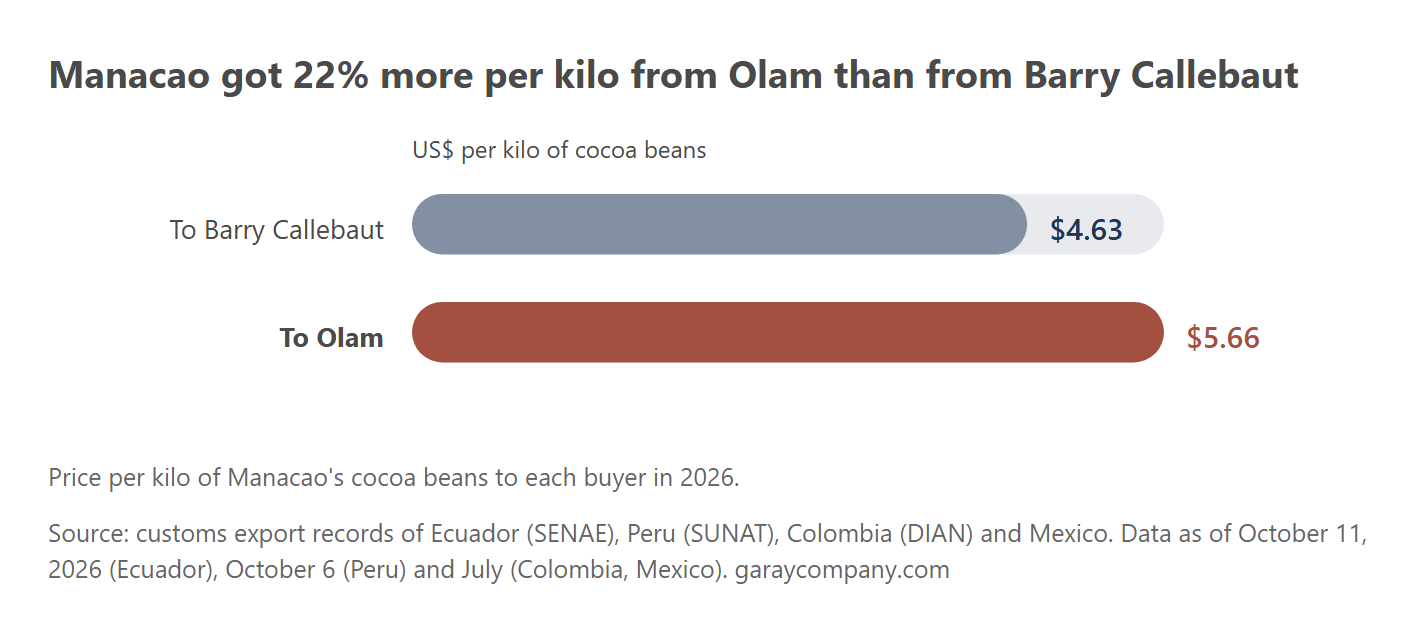
And one supplier got two prices. Manacao sold to Barry Callebaut at US$ 4.63 per kilo and to Olam at US$ 5.66.
Prices inside the same company
Four of the ten buyers also received beans from their own company in Ecuador: Barry Callebaut, Cargill, Nestle and Olam. Those shipments are transfers inside the same group, and I left them out of every average above. They add up to 15% of the value the four countries exported.
Their declared price is still worth reading next to the price the same group paid to other suppliers. Barry Callebaut declared its own Ecuadorian beans at US$ 6.67 per kilo and paid other Ecuadorian suppliers US$ 5.06. Olam's transfers were declared at US$ 6.34, against US$ 4.77 from other suppliers. Cargill's were US$ 5.06, against US$ 4.99. Nestle received all of its Ecuadorian beans from its own company, at US$ 5.11 per kilo.
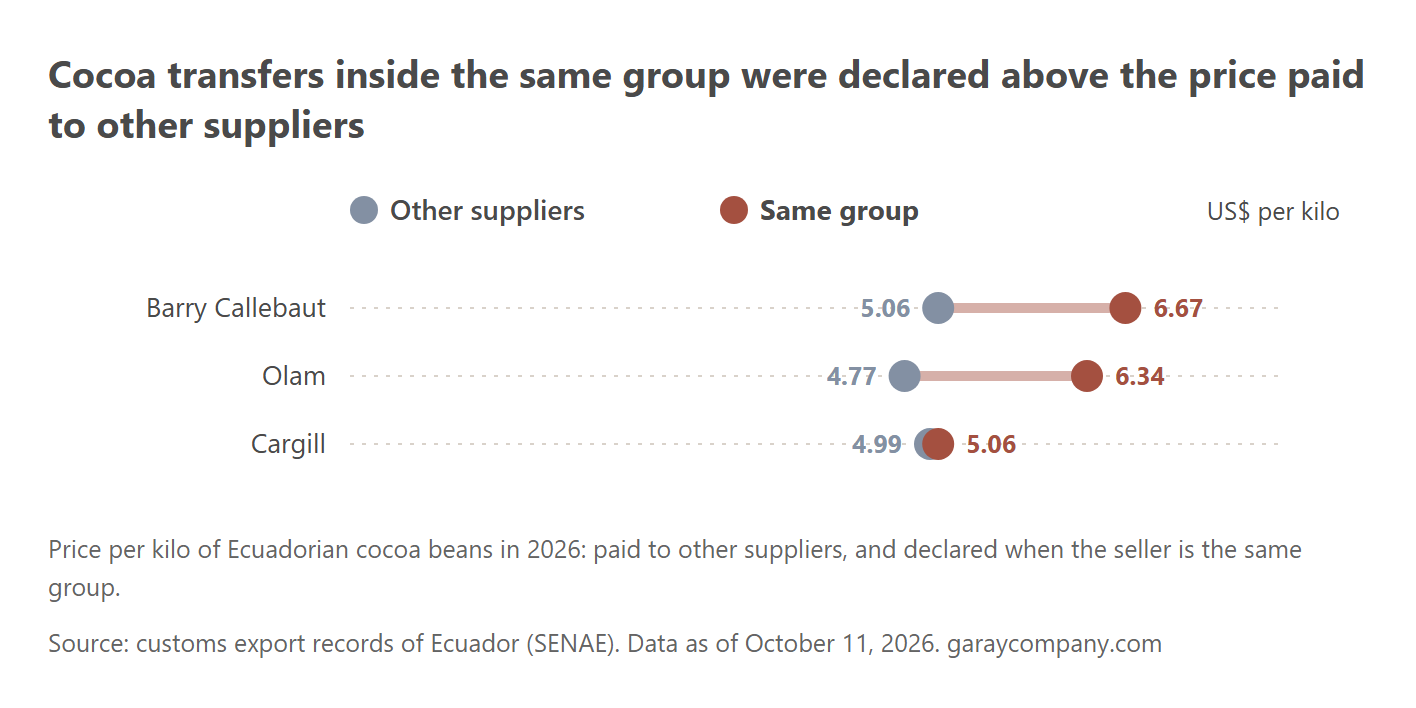
In the three cases with both prices, the transfer price was higher than the price paid outside the group. Part of the gap can come from timing, since the two flows did not leave in the same months.
An exporter cannot change where its beans grow. It can choose who it sells to and, within limits, when it ships. In 2026 those two choices moved the price per kilo more than the origin did. That said, the buyers that paid the most were most likely paying for a different quality of bean, so the lesson is to match each lot with the buyer that values it.
In practice, that turns into three questions for any exporter. Which buyers paid above the average of my country, and for what kind of bean? In which months did the price of my origin recover, and can my harvest and my contracts reach those months? And does my current buyer pay other suppliers more than it pays me?
The customs records answer the first and the third with names and prices. The second comes from the monthly averages above, and it repeats across the three countries with enough shipments.
The numbers show it from three sides. Within Ecuador, Atlantic Cocoa paid US$ 8.21 per kilo while Olam paid US$ 4.77. Within one year, Peru's average went from US$ 3.67 in April to US$ 5.82 in September. And within one supplier, Manacao got US$ 4.63 from one buyer and US$ 5.66 from another.
That is why I look at the list of buyers, with what each one pays and to whom, before I look at the average price of a country. The average tells you where the market is. The list tells you where your next sale can be.
The World Cocoa Bean Buyers Radar gives each of the largest buyers its own page, with the price it paid by origin and its five main suppliers.
The numbers behind this
| Buyer | Average, US$ per kilo | Ecuador, others | Ecuador, own group |
|---|---|---|---|
| Atlantic Cocoa | 7.17 | 8.21 | |
| Agroindustrias Unidas de Cacao | 6.40 | 7.19 | |
| GCB Cocoa | 5.07 | 5.31 | |
| Nestle | 4.98 | 5.11 | |
| JB Cocoa | 4.93 | 5.03 | |
| Stonex | 4.93 | 4.93 | |
| Cargill | 4.87 | 4.99 | 5.06 |
| Barry Callebaut | 4.85 | 5.06 | 6.67 |
| General Cocoa | 4.69 | 4.70 | |
| Olam | 4.50 | 4.77 | 6.34 |
| All buyers | 5.33 | 5.43 |
Get the list of world cocoa bean buyers
Every buyer of cocoa beans from Ecuador, Peru, Colombia and Mexico in 2026, ranked by value, with the price each one paid per kilo and its suppliers.
See the buyer listFrequently asked questions
What is the average price of cocoa beans in 2026?
US$ 5.33 per kilo across Ecuador, Peru, Colombia and Mexico, leaving out intra-group shipments. Ecuador averaged US$ 5.43, Peru US$ 4.90, Colombia US$ 4.51 and Mexico US$ 3.72.
Which cocoa bean buyer paid the most per kilo?
Atlantic Cocoa, with an average of US$ 7.17 per kilo and US$ 8.21 for Ecuadorian beans. Agroindustrias Unidas de Cacao followed at US$ 6.40.
How much do Cargill and Barry Callebaut pay for cocoa beans?
Cargill paid US$ 4.87 per kilo on average and Barry Callebaut US$ 4.85, both below the US$ 5.33 average of all buyers.
Do large buyers price their own shipments lower than other suppliers?
Not in Ecuador in 2026. Barry Callebaut declared its own beans at US$ 6.67 per kilo against US$ 5.06 from other suppliers, Olam at US$ 6.34 against US$ 4.77 and Cargill at US$ 5.06 against US$ 4.99.
How much of the cocoa bean trade is intra-group?
15% of the value exported by Ecuador, Peru, Colombia and Mexico in 2026 moved between companies of the same group.